
Facebook
Twitter
Linkedin
Youtube
Instagram
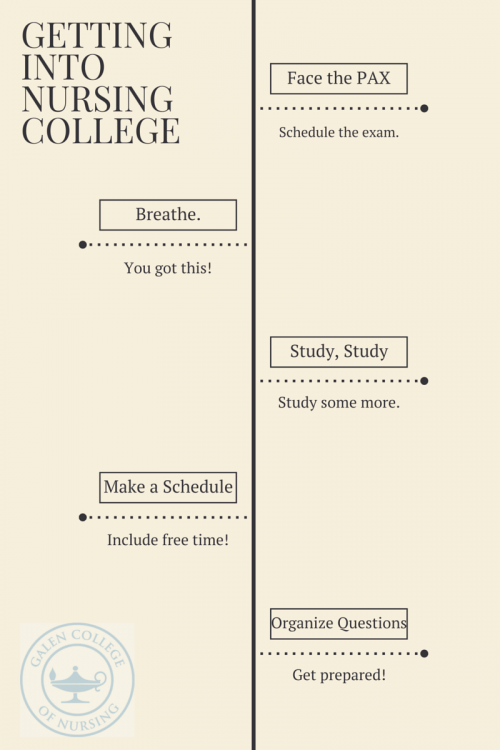
Getting into Nursing College
So, you’ve made the call, spoken to your nursing college of choice and have made an appointment to visit with the Admissions team. Congratulations! The good news? The hard part is over and you’re one step closer to starting your nursing career! The other news is that there’s still a lot of work to do before you’re actually enrolled in nursing courses. The most daunting part of the college admissions process can simply be uncertainty; not knowing what to expect can make you feel overwhelmed by all of the information you’ll begin to receive. We want to help rein in all of the pieces and simplify this process for nursing hopefuls, so you can hit the ground running and earn your nursing degree.
Face the PAX: The Entrance Exam
Some people are just naturally great test takers (and yes, us anxious test takers are envious), while for others, just the idea of taking a test causes a cold, clammy panic. Either way, we’ve noticed that many people tend to either greatly over, or greatly underestimate the NLN PAX (National League for Nursing Pre-Admission Examination), which is the standardized entrance exam for nursing program students. But you can pass this test! First, determine the best learning style for you. We like this short quiz at EducationPlanner.org to get you started. Do you respond best to visual aids, audio, graphs, or by doing? What’s the best way for you to study?
More often than not, the test fee is non-refundable, so don’t schedule the test unless you are serious about taking it. (Note: You have up to a year to take it, so don’t worry if you’ve just got cold feet!)
Next up – Remember to breathe. You can do this! Hit the books and begin studying right away. There’s no use in prolonging the inevitable. Create a timeline and stick to it, plain and simple. Most importantly, ask for help if you need it, and take advantage of ALL of the study guides and practice tests. It really can make all the difference. We recommend the following PAX study guides:
- Review Guide for RN Pre-Entrance Exam, 3rd Edition ISBN: 9780763762711 Author: National League for Nursing
- Review Guide for LPN/LVN Pre-Entrance Exam, 3rd Edition ISBN: 9780763762704 Author: National League for Nursing
Scheduling
This is major. We are all guilty of overestimating how much available free time we really have. Think about it and honestly tally up the hours of each day that are not spent working, commuting, taking care of personal and family responsibilities, or sleeping. Until we find a way to add more hours into each day, we’re going to have to work with the 24 we’ve got. Nursing students must be willing to make temporary lifestyle changes in order to earn their degrees and pass boards. There are many hours where you’ll need to be physically and mentally present; in class, clinicals, and study time, in addition to life’s other demands. The key is to be honest with yourself and make sacrifices you can live with for a year or two, knowing that you can reevaluate at the next step. And no matter what, hold on tight to some of that precious “me time” because you’ll need it to recharge and stay healthy (and sane!). Last but not least, make sure you have a support network of reliable friends and family who will be able to step in to help when you’re thrown the occasional curveball. Always have a Plan B, and while you’re in nursing school – might as well have a Plan C and D just to be safe.
Come Prepared
If you have questions about specific transfer credits, you’re not alone. Your best bet to get a quick answer to those questions is to bring your Official (unopened) Transcripts from any previous college coursework to your information session. Also, make sure to bring your photo ID and high school diploma or GED (even if you’ve already completed a college degree). You’ll be taking in a lot of information, so bring a list of questions or concerns you’ve written out beforehand to help you stay on track. Get a head start and researching information on financial aid. Check out different types of loans and repayment plans and have an idea of how you’ll be paying for school. Get a step ahead and fill out a FAFSA here. If you have questions, just give the Financial Aid department a call and they’ll walk you through it.
Most of all – Believe in yourself! Deciding on a career path is a huge decision and a pivotal moment in life. You should take great pride in joining the elite ranks of Florence Nightingale! We’re happy to help get you in a classroom seat and on your way to becoming the amazing nurse you were always meant to be.

Nursing Specialty Certification
Nursing is an incredibly diverse profession with opportunities to grow in various specialty areas; cardiac care, education, labor and delivery, nursing management, and pediatrics, just to name a few. No matter the profession, most of us do not know exactly where we will end up in our professional careers, and over time, our goals evolve and grow. (That’s perfectly normal and to be expected!) A career in nursing allows you to explore your specific interests and passion for care while leaving plenty of room for exploration and growth. You can work where and when you want with many options for full or part-time positions.
To maximize your earning potential, though, you might want to look into certifications. Nursing specialists who obtain certifications earn more than those who have no specialty certifications. According to Monster.com, there are many popular certifications that can increase your value as a nurse while also helping you get a foot in the door of your desired specialty area. We’ve just begun to scratch the surface, but here are a few which can guide you along your nursing career path:
- CPHQ (Certified Professional in Health Care Quality) Going the extra mile to obtain health care quality certification shows your commitment to quality development measures and systems, which can eventually prepare you to take on an administrative role at your organization.
- CHPN (Certified Hospice and Palliative Care Nurse) CHPNs are special kinds of people who work with grieving patients or patients experiencing terminal illness. They focus on the physical, psychological, emotional and spiritual needs of patients and their families.
- CCM (Certified Case Manager) CCMs are encouraged to adopt a much more holistic approach to the treatment of the patient. They are involved with the immediate needs of patients, but they also address less critical needs to maximize the overall health of patients.
Continue the conversation: Check us out on Facebook and tell us about your specialty and the certifications that helped you get there.
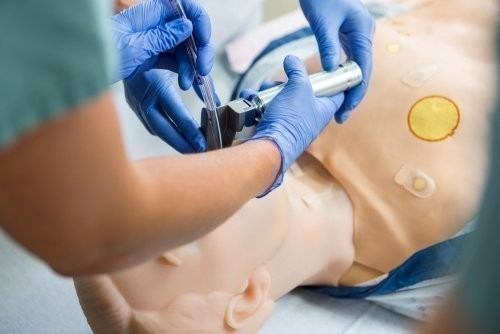
Simulation Helps Prepare Nurses for Reality
It’s been said that we learn by doing, and nursing is unquestionably a profession in which possessing knowledge and information can only get you so far. Simulation and Clinical Learning Labs enable students to act out a medical scenario in order to problem solve in real time and determine the most effective solution. Not only is this a great way to get a head start on hands-on clinical learning, but it will also boost confidence and prepare a nurse for future real-world situations. A bonus for the fact and stat-riddled brains of nursing students? In this method of active learning, science has proven that simulation helps students to better retain knowledge. (Science!)
Here’s how it works:
Say you’re currently learning how to care for a cardiac patient; more specifically, a patient that is having a heart attack. Students in the sim lab will begin with pre-briefing, followed by the actual simulation, and will end with a debriefing.
Pre-briefing includes information on what to expect during the simulation, a review of the medical diagnosis, and a definition of the simulation objectives.
Simulation itself is the main act of the scenario and often mirrors a patient that a nursing student will encounter in clinical.
Debriefing is facilitated by faculty after the simulation and consists of a student round-table discussion to decide if the nursing care during the exercise could have been improved or changed, and what the best continuing care for this patient would be. (Fun fact: Simulation will always be broken down in this manner, and research surprisingly indicates that the greatest amount of learning takes place during the final stage of de-briefing.)
The simulation experience is embedded with concepts that are important for student nurses to learn, such as patient safety, critical thinking, delegation to other health care workers, and inter-professional collaboration. Working together with a team of nurses to achieve the best possible outcome for a patient is a crucial skill to master in nursing.
As you may have put together, simulation is not specific only to nursing – this technique has actually been borrowed from the field of aeronautics. Pilots spend a lot of time in an aircraft simulator, and every “miss” (crash) or “near-miss” (you get the idea) is simulated by every pilot, from UPS to Delta to the United States Air Force. Remember the pilot that landed successfully on the Hudson River? That pilot, along with every other licensed pilot since the incident has practiced that exact maneuver in the months after it occurred. Anesthesiologists are beginning to require simulation as part of re-licensure, and other health care workers, such as physicians and dieticians, complete simulation during their training, as well.
Simulation has certainly gained popularity over the years as more research has proven its incredible value. The best part about it? No matter what you do (or do not do), you absolutely cannot kill the Sim mannequins! Whatever happens, that Sim man/woman will start right up for the next activity. Participating in simulation is a bridge from education theory and nursing knowledge, to caring for real patients in real-world settings, without putting patients or new nurses at risk. It really is a win-win.
Beginning nursing students gain confidence and muscle memory from simulation, and more experienced students can master more advanced nursing concepts. Galen College of Nursing strongly embraces simulation as a strategy for learning nursing concepts, and simulation is used in approximately 90% of our nursing courses. Galen understands this method of preparing nursing students is paramount in quality patient care and safe clinical environments – and we want to make sure our nurses are the very best nurses working in the field.

Americans Rate Nurses Highest in Honesty and Ethics
The people have spoken. And nurses are listening.
Americans have once again rated nurses highest on honesty and ethical standards in this year’s Gallup poll. (Related: Americans rated members of Congress and car salespeople the lowest among the 11 professions included in this year’s poll.) Nurses have generally topped this list since they were first included in the poll in 1999, and folks continue to rate those in the medical field highest on this list overall; runners-up for the number one spot were medical doctors and pharmacists.
Nurses are heralded as being on the front lines of patient healthcare. They are often able to provide more direct, one-on-one care, deliver information more frequently than other members of medical teams, and tend to develop more intimate and personal relationships with patients and their families as a result. But the value of a nurse doesn’t end there. Nurses also serve in leadership positions relating to health policy and reform, quality of care, administration, wellness and prevention, and more. We advocate on patients’ behalf whether we are at the bedside or in the boardroom,” says American Nurses Association President, Karen A. Daley, Ph.D., RN, FAAN.
If history is any indication, it appears that Americans continually value and have confidence in our nurses, and this is nothing but good news for the profession as a whole as demand for nurses in the workforce continues to increase. While we can all agree that paychecks are important, most nurses don’t go into the profession solely for monetary gain. Nurses become nurses because they are called. They have an unrelenting passion for helping people and strive to make the world a better place by providing compassionate and knowledgeable care to those in need. Hearing that calling, following it, and knowing that you’re in a respected and trusted field brings a deeper sense of job satisfaction that can be difficult to find elsewhere.
So, if you’re already a nursing student or a working nurse – keep up the great work! If you’re considering a future in nursing, rest assured that your choice will be sound one, because you just can’t do much better than having the most respected career in the country.
RELATED ARTICLES: The Heart of the Matter: Emotional Rewards of Nursing

Emotional Rewards of a Nursing Career
Though it can be physically exhausting, and often times a true test of your strength, nursing offers unique emotional fulfillment, unlike any other career path. In this profession, you’ll find that the benefits far outweigh any of the challenges. The happy tears will be just as valuable as the sad ones, and the impact you will have on your fellow human is simply immeasurable. And it’s true that when your heart is in it, it’s less ‘work’ and more of a “calling.” We’ve highlighted a few of these emotional incentives below.
- Compassion: Gandhi – the epitome of compassion – is quoted to have said, “The best way to find yourself is to get lost in the service of others.” In helping to heal others when they are at their most vulnerable state, you will experience compassion for another human being like never before. Not only will they remember the positive impact you made throughout their lives, but compassionate care can also play a direct role in increasing the coping levels of patients.
- Camaraderie: Nursing is not a solitary job, and it certainly takes more than one medical professional to care for a patient. When several people come together for a greater purpose, strong friendships and solid professional relationships are also created. Also, nurses share an uncanny ability to bond through humor. (And we think nurses probably have some of the best senses of humor, maybe as a result!)
- Feeling Valued: It’s no surprise (to just about anyone) that nursing is a tough job, to say the least, and those equipped with the skills to be a great nurse should be heralded and cherished. It may not always feel like it, but nurses are looked up to and held in such high regard. When their family member or loved one is receiving medical care, you are their first advocate, and sometimes, their first impression of the medical facility.
- You’ve got options: One of the best things about a career in nursing is that unlike some paths, you’re not limited in career growth. Not only do you have the ability to choose what type of facility you will work within (hospital, clinic, small practice, school, etc.), but you also have many opportunities to work within varying units, departments, and even nursing specialties. Having this option is always nice and helps to cultivate personal and professional growth. It also helps avoid burnout, which can infect other career fields.
You will discover completely unique emotional rewards in your own experiences as a nurse, and each will be important to you in different ways.
What are some of the personal rewards you have found in your career? We’d love to hear your story, so please share your experiences with us on one of our campus Facebook pages below.
Cincinnati | Louisville | San Antonio | Tampa Bay
RELATED ARTICLES: Americans Rate Nurses Highest in Honesty and Ethics | Twenty Things I Wish Someone Had Told Me About Being a Nurse | The Heart of Giving: Habitat for Humanity

Simple Health Changes
As the Marketing Director at Galen, you can imagine I’d be excited about our new blog. So much so, that I agreed to write something for it. Sure! I said, months ago, thinking I would have plenty of time to come up with something relevant to nursing students, education and how cool I think it is that so many of you have crazy busy lives, yet are figuring out how to fit in nursing school education to pursue this great career.
But I keep finding myself wanting to write about something else, besides Galen and nursing, that is near and dear to my heart. Because I see and hear first-hand how hard nursing students work and I put two and two together–that you are not always putting yourself, and your health, first. And don’t roll your eyes, yes, your health. In my spare time, I am a bit of a fitness and health fanatic. I teach spinning classes and am a long-distance runner (ran in the Boston Marathon this past April, but that is for another blog post).
I would like to make a few suggestions that are not a diet, they are not a New Year’s resolution, and they are simple, easy things we can do to improve our own health. We are the first line of defense to illness and disease. Not the health industry, not your doctor and not you when you become a nurse and start self-diagnosing your own symptoms! There are easy things we can do that will make a difference over time. Here goes:
- Take the stairs! If you have to go only one flight, you can manage the stairs. I promise.
- Limit the soda (pop if you’re from up north). I’m not saying cut it out, but talk about empty calories that serve absolutely no purpose and have been linked to all sorts of baaaad stuff.
- Drink water.
- Drink more water.
- Refer to 2 and 3.
- Instead of mayonnaise on the sandwich, try just mustard. It won’t kill you. I promise.
- Park in the last spot, furthest away from the front door (assuming it’s not raining, and you are not late for class).
- Processed food is a part of life. I get that. But when you can, go au naturel.
- Bring munchies from home. An apple, an orange, a banana with a little plastic container of peanut butter, almonds, throw a box of Triscuits in your backpack.
- Speaking of oranges, don’t drink fruit juice. Fruit is sugar enough naturally. Fruit juice, killer. And to, forget your vitamins is not an excuse. Sugar, like in #2, is linked to all sorts of baaaaad stuff. Eat the real thing and save your thirst quencher for water!!
See, that wasn’t so bad! You don’t have to turn your life upside down and make all sorts of hard to keep promises to do something better for yourself now. Little things add up. If you want to make bigger changes, sometimes you have to start small.
Yours in health, and to a great future!
— Anna Kitson is Marketing Director for Galen College of Nursing.

Time Management for Nursing Students
Nursing school is a commitment; it is an emotional, financial and personal investment.
You have the heart and the desire to become a great nurse, so you dedicate yourself to being an excellent nursing student. Then you find out – while it is rewarding, nursing school is also challenging! No one breezes through nursing school, and almost every student will reach a tipping point where changes must be made in order for goals to be achieved. That’s normal, and how we grow as individuals. With that in mind, we’ve outlined some of the most common issues that nursing students face and ways to overcome them.
- Class Attendance:
- Attend every class.
- (Yes, it is that simple.)
- Bad Study Habits:
- At the beginning of each quarter, set aside time to MAKE time. Use a calendar where you can see the entire quarter, in full. This will help you make the most of your time and set realistic goals for yourself.
- List all of your assignments, exams, and personal commitments on one calendar.
- Set personal deadlines to complete tasks before the last minute. Load up your smartphone or another type of automated reminder system with important dates.
- Understand that studying is additional time reviewing material, whereas reading the chapter for class and completing assignments are considered NOT study time.
- Set up time throughout the quarter (never more than three consecutive hours) to study each week.
- As you are reviewing material before the test, write questions down to remind yourself to ask your professor BEFORE the day of the test.
- Find out if you study better in a group or on your own and do that.
- Test Anxiety:
- Every student experiences test anxiety so do not feel that this is your body trying to attack you personally.
- Remember to breathe. After every page of questions in an exam, set your pencil down and take one deep breath.
- Do not huddle around your friends before the exam and try to learn something brand new in the 10 minutes preceding the test; your brain doesn’t work that way.
- Breaking Down NCLEX-Style Questions:
- Read the questions slowly.
- Cover the answers when reading the question and think about what the answer might be before looking at your choices.
- If you get it down to two answers, rewrite the question as a statement filling in each of the possible answers to see which sounds better as a true/false statement.
- Balance:
- Find time away from nursing school, even if it is limited.
- Don’t cut off family and friends entirely. Although you may need to reduce social activities, it is important to keep your support network strong.
- Reward study time and difficult assignments with doing something you enjoy. (i.e. crafts, TV, video games, exercising, etc.)
Remember to be kind to yourself and always look out for the future when it comes to managing your time. Don’t sweat the small stuff and explore ways to improve when specific challenges keep cropping up. Although nursing school is not for the faint of heart, we know that those who are called to become great nurses are not faint-hearted in the first place!

EBP and Information Literacy
What You Need to Know About Evidence-Based
Practice (EBP) and Information Literacy
If you’re already a nurse or nursing student, you may already know a little something about these two concepts. They are not only important to your success as a nursing student (or practitioner once you graduate), but also to your savvy as an engaged healthcare consumer and member of the community. Read more to discover their relationship, and how these concepts will play out interdependently throughout your nursing career.
Evidence-based practice (EBP)
First of all, there are several different competing models of implementation for EBP, each having its own set of numbered steps that can be followed to answer a clinical question such as, How do I best prevent pressure ulcers in a bed-ridden patient? While choosing a model for your personal or team use is important, our chief concern here is to understand the primary principles of the system itself, not to dive into a slew of EBP models that have been published at one time or another.
For simplicity’s sake, we’ll stick with the model outlined by Dr. Bernadette Melnyk in an outstanding series of articles published in the American Journal of Nursing called, Evidence-Based Practice: Step by Step. In the first article in this series, Dr. Melnyk defines EBP as a problem-solving approach to the delivery of health care that integrates the best evidence from well-designed studies and patient care data and combines it with patient preferences and values and nurse expertise It enables nursing care to be more individualized and dynamic. According to Dr. Melnyk, the steps to EBP are:
- Cultivate a spirit of inquiry.
- Ask clinical questions in PICOT format. Inquiries in this format take into account patient population of interest (P), intervention or area of interest (I), comparison intervention or group (C), outcome (O), and time (T).
- Search for the best evidence.
- Critically appraise the evidence.
- Â Integrate the evidence with clinical expertise and patient preferences and values.
- Evaluate the outcomes of the practice decisions or changes based on evidence.
- Disseminate EBP results.
Simply put, the essence of evidence-based practice is to ensure that the scientific component of a clinical decision is based on sound, robust, up-to-date research. This is peer-reviewed research which has been conducted as rigorously as possible and reviewed by a panel of subject experts. Preferably, there are several studies published on a given topic that is synthesized to yield a consensus.
Information Literacy
Information literacy is defined by the American Library Association as, a set of abilities requiring individuals to recognize when information is needed and have the ability to locate, evaluate, and use effectively the needed information. In short, it’s a vital skill set to possess in the pursuit of knowledge. You should know, though, that the Association of College & Research Libraries also publishes information literacy standards geared specifically toward nursing. These nursing-oriented standards declare that an information literate student or practitioner is able to:
- Determine the extent of information needed
- Access the needed information effectively and efficiently
- Evaluate the information and its sources critically
- Incorporate selected information into one’s knowledge base
- Use information effectively to accomplish a specific purpose
- Understand the economic, legal, and social issues surrounding the use of information, and access and use information ethically and legally
The Nexus
Now that we have a basic understanding of what the concepts of information literacy and evidence-based practice are individual, let’s think about their relationship. The research we need to access for EBP is primarily published in scholarly journals. Thirty years ago, these journals were print publications mailed to subscribers. A student would consult the index for all relevant articles, look up the location of the desired journal issues, and walk to them in the library stacks. Oftentimes, each article would then be photocopied and inserted in a binder for further work outside the library. To millennials or digital natives, this process probably seems ridiculously labor intensive. Even for those of us who may have actually used this old system at some point, reflecting on it in the light of contemporary practices shows us just how far we’ve come. Thankfully, digitization and computer networking have brought the stacks to our desks. Although subject headings are still assigned to every journal article, the indexes are now digital, and the full text of the articles is linked from the index. We call these electronic resources databases.
What does this mean for you?
Galen invests heavily in subscriptions to an excellent collection of databases for students and faculty which includes CINAHL, MEDLINE, ScienceDirect, Nursing@Ovid, Nursing Reference Center, and Academic Search Elite. You can get to these from the library home page here, or if you’re off campus, from inside Canvas under the Library & Resources link on the home page. There are also free resources that can help, such as Google Scholar and PubMed. Choosing which database is right for your project, knowing how to use it, and getting what you need from the research you collect is the essence of information literacy.
The bodies of knowledge of information literacy and evidence-based practice are inextricably linked. To a nurse, one is no good without the other. You can find contact information for your local campus librarian and an online help request form on the Galen libraries home page. Call us, email us, or stop by for in-person assistance as you continue on your journey toward becoming a great nurse.
RELATED ARTICLES: Balancing Act: Realistic Time Management Strategies for Busy Nursing Students.

Habitat for Humanity build
“Happiness consists in giving, and in serving others.” – Henry Drummond
Each quarter, Galen College of Nursing’s Student Nurse Association begins the heartfelt and rewarding task of participating in a Habitat Humanity build in the Tampa Bay area. On September 24, 2014, we contributed to the Long Family’s home, and in a strange twist of fate, we learned that Nakia Long has been employed within the healthcare profession for over 10 years and that the home would provide shelter to Long and her son, Ke’andre.
During the build, Galen students and staff came together to add finishing touches to the home. We worked tirelessly until mid-afternoon, side by side with other volunteers as we lay sod in the front and backyard of the property. It was a long day, to be sure, but the sense of accomplishment and pride prevailed, and we truly learned the value of a hard day’s work. (And a lot of sweat!)
It warms my heart to know that this house stands today because of the commitment of others; a community of caring people selflessly dedicated to providing affordable housing for families. When thinking of the comfort this home would provide for the Long Family, I thought of none other than Florence Nightingale, “The Lady with the Lamp.” Florence’s lamp signifies comfort bestowed to those in need. Long, who dedicates her own life to the care of others, will now have a place to lay her head. It is my hope that as she drives home each night, this home also serves as her comfort, her anchor and her lamp. I am beyond proud to have been a part of the Galen team, which continues to contribute to the improvement of our community.
During the dedication of the home, I was personally able to speak on behalf of Galen College of Nursing Volunteers. We also heard from Habitat Pinellas CEO, Mike Sutton, and U.S. Representative David Jolly. It was a transformative experience for me, and it is just one of many service-oriented projects that Galen has been able to participate in. It’s through these ventures that we’re able to further embody the Galen philosophy of C.A.R.E. (Character, Accountability, Respect, and Excellence), both as an institution and as individuals.
We would like to offer sincere gratitude to our Student Nurse Association Community Service Chair and ADN student, Divyia Joseph, who coordinates each of our quarterly Habitat for Humanity builds. We would also like to encourage everyone to consider participating in builds like these. There is no greater feeling than taking in the emotion as new homeowners are handed keys, and the welcome mat is laid out! As always, we look forward to continued participation in these opportunities which enrich and serve our communities and provide a lamp for those in need of a guided path.

20 Things I Wish Someone Had Told Me About Becoming a Nurse
Let’s face it – no matter what it is, when you’re about to make a huge life change, knowing what to expect can ease the anxiety of the unknown.
Having some inside information from someone who’s been there themselves can make the journey a little less intimidating. With that in mind, we spoke with a couple of top-notch Galen nursing instructors, Dara Lanman, MSN, RN, CNE, and Frances Anderson Ph.D., RN, APRN, CNE, and compiled a list of the top 20 things they wish someone had told them before they got their nursing degree. (And, yes, they’d still do it all over again!)
- Nursing doesn’t just involve patient care. You can be a nurse and work in hospital management or the field of education. You can help to sell medical equipment used by hospitals, and there are also important roles in medical insurance and medical law which require the specialty of a nurse.
- Working as a nurse can bring out the most extreme of emotions. You might go from mourning the loss of a patient that you had grown close to, to singing from the mountain tops as a patient who was not expected to make it is well enough to go home. This is likely to happen on the same day, maybe even the same hour.
- You will make such a difference in so many people’s lives, on a daily basis. Even walking through a grocery store, you might be stopped by someone who remembers you at their bedside giving them hope when they needed it the most.
- Oh, the places you’ll go! You’ll have the opportunity to travel around the world assisting those who need your care, while also getting to experience different countries and cultures.
- Nursing lets you work in all sorts of environments; from caring for newborn infants taking their first breath, to providing comfort to an elderly person taking their last.
- You may end up working in various medical settings – a private practice, a public clinic or school, a business, or even making home visits to the public.
- Make no mistake – nursing school is hard. You will learn that answers do not always come quickly, but when the first patient tells you that you’ve made a difference, it will all be worth it.
- Helping someone who was never supposed to walk again take their first steps, or being there when someone born deaf hears their first sound will cause you to cry – and that’s okay.
- Sometimes, holding a patient’s hand is all that a nurse needs to do.
- Portrayal of the medical field on TV shows such as House, ER and Grey’s Anatomy are not real! (After all, there aren’t even any nurses on House!)
- If you talk about “the patient with anal atresia” at the dinner table, your seven-year-old child will go to school the next day and talk about it at Show & Tell. (True story!)
- When you walk into a crowd of people, you can’t resist diagnosing everyone as they walk by.
- Friends, neighbors and even people that you’ve never met will ask you to diagnose their rash.
- When one of your children has a headache, you are sure that he or she has some rare type of cancer that you just studied.
- You will learn to identify smells that one does not even want to talk about.
- On that note, you will learn that one can get really excited about the color of various bodily emissions.
- Just when you think you have heard it all, you haven’t, because you’re going back to work tomorrow.
- You’ll learn that some people have 48 hours off in a row, and they call it a weekend.
- You will begin to love talking about rare diseases, while your friends and family will stand there with a glazed look on their face, horrified at the story you just told.
- When you go to work every day, you are reminded that there are a lot of people in the world who need to be cared for, and you will be thankful that you have the honor of caring for them.
More about Dr. Anderson:
Dr. Anderson has been at Galen College of Nursing for four years. She teaches the first of the medical-surgical classes in the Bridge program. Dr. Anderson earned her BSN from the University of Kentucky, her MSN from the University of Texas at Austin, and her Ph.D. in Nursing from the University of Washington. She spent 22 years on active duty in the Army Nurse Corps and retired as a Colonel. Following this, she returned to the University of Alabama and earned her family and pediatric nurse practitioner certification. She spent 10 years in full-time practice as a Pediatric Nurse Practitioner prior to coming to Galen.
More about Professor Lanman:
Ms. Lanman is the Director of Curriculum, Instruction & Assessment at Galen College of Nursing. She has been with Galen for over 12 years, having worked as Director of the RN Program, Associate Professor and Academic Success Coordinator in addition to her most current role. She received her BSN and MSN from Bellarmine University in 1999 and 2005 and is currently pursuing her Ph.D. of Leadership in Higher Education from Capella University. Ms. Lanman’s nursing specialty area is critical care, but she has experience in many types of ICUs such as Neurological, Medical Surgical and Cardiac. She has also worked in the areas of Bone Marrow Transplant, Stroke and Seizure, and multiple ER units. She is a proud member of Greater Louisville Council of Critical Care Nurses, the Kentucky League for Nursing and Sigma Theta Tau International Honor Society.